Most days, as I commute to take my toddler to daycare and then back to my home office, I frequently find myself saying in my head “your lack of planning in not my emergency,” as people ride on my rear, throw their hands in the air, and even pass in no passing zones. It is my gentle reminder to myself that I don’t own their frustrations, nor do I have to change my behavior or my rate of speed because of their irritation.
I do follow the speed limit *gasp* not only for safety and respect reasons but also to be an example to my child. I use my blinker. I also stop at stop signs and yield at yield signs, even when no one is around to see me. I do this because I honor the lives, safety, and health of others (and I want my child to know that this is how we respond to those around us, with regard). I acknowledge that my responsibility as a driver is to behave in such a way that we all make it home at night to our loved ones, family, friends, fur babies, lizards, whatever it might be. But that is not what prompted this writing today.
This morning, as I was driving back home from daycare drop-off, I had an individual doing all the things I had listed above. Riding my rear, throwing hands, and I am sure if they had been able to, they would have driven through the ditch to get to their destination quicker. I have had this thought before, but it struck me again today: It is likely partially their lack of planning, but it may also be (to a huge degree) their lack of embodiment. Their experience of detachment and disconnection.
What do I mean by that when I say embodiment? To me, embodiment is being fully connected to ourselves, our body, our sensations and emotions and the present moment. In a sense it is like mindfulness but rather than practicing and experiencing awareness and focus, embodiment is practicing and experiencing connection. They are closely related and have quite a bit of crossover.
A couple years ago I took an embodiment certification course. I was in a small group with some fabulous people from around the country, and we met each week to practice with each other and discuss our curriculum. On one occasion we were discussing how being disembodied (a sense of detachment or disconnection from one’s own body, emotions, or surroundings, manifesting as a feeling of being separated from physical sensations, emotions, or the present moment) can be attributed to so many things in our society. The behavior of our politicians, the feeling of tension in so many public places, the big (seemingly exaggerated) responses to life events and inconveniences we see from people, etc. We discussed how different our communities and the world might be if more people took the time to not only be mindful but to connect, to become embodied.
Today, I was reminded of all those things. The importance of embodiment. How being disembodied leads us to behave in ways that we may not be so proud of if we had that connection and took the time to be aware and present. How our disembodiment puts tension into the collective space. How being in a hurry is a sign of disembodiment.
So how do you know you are disembodied? Here are some examples:
- Dissociation
- Difficulty in feeling or expressing emotions
- Physical discomfort
- Being in a hurry
- Impatience with others
- Disconnection from surroundings
- Memory gaps
- Avoidance of physical sensations
- Too much screen time (tv, phone, or even reading)
- Emotional shutdown
- Eating on autopilot
- Daydreaming
- Multitasking without focus
- Auto responding to conversations or emails
- Perfectionism
- Responses to situations that appear to be emotionally immature
- Responding to fear ineffectively (suppressing, illogical, divisive)
And the list goes on and on…
My mind’s gentle reminder brought empathy into my body for this person. While they were clearly driving in a way that I would not deem safe, I found a sense of connection with myself and then with them, identifying that they were likely experiencing the world (at least in that moment) in a way that was disconnected from themselves and from others (me).
Now, don’t think for one second that I don’t have those moments too. I struggle with being mindful and embodied on the regular. I find that for me, these moments are usually when I am dysregulated. They probably go hand in hand. It is ongoing work to be connected and aware.
So, did any of those examples relate to you or someone you know? I could almost guarantee that they did. My sure signs of disembodiment in myself are dissociation (usually with a screen), memory gaps, and impatience. I also occasionally find myself multitasking without focus and being a bit of a perfectionist (that one is a long-fought battle of a first born with type A personality and recovering people pleasing personality, or so the theories go). We all have some tell tale sign of disconnection in our body. Identifying those and finding ways to be more aware of them can make a big difference in how we relate to ourselves and those around us.
One thing to note about embodiment is that it isn’t a one-time thing. It is a practice. It is something we must keep doing every day for it to work and keep working. Kind of like eating healthy and exercising, we can’t do it once and expect to look and be fit and healthy. Here are some examples of ways to become more embodied:
- Regular body check-ins
- Body scan meditations
- Mindful breathing
- Yoga
- Tai chi
- Progressive muscle relaxation
- Somatic work
- Grounding
- Dance or movement meditation
- Sensory awareness
- Nature connection or earthing
- Creative expression
- Mindful eating
- Qigong
- Meditation/mindfulness in motion
- Feldenkrais method
- Martial arts
- Play
- Mindful stretching
- Floatation tanks
- Body-informed decision making
- Progressive grounding
- Self-massage
- Laughter yoga
- Positive affirmations
- Gratitude practice
- Imagery or visualization
- Sound therapy/healing
- Five senses grounding/check-in
- Embodied communication
- Nervous system regulation exercises or practices
- Free flow dance
- Improv
- Tapping/EFT
- Reiki
- Animal connections
- Co-regulation
This is not an exhaustive list, but these are some tops ones that came to mind that I frequently recommend to my clients as we work on their unique healing journeys.
A big part of healing, maybe the biggest part, is connecting. Reconnecting and connecting to ourselves, and others, and the planet. Everything. I firmly believe that we cannot heal until we reconnect.
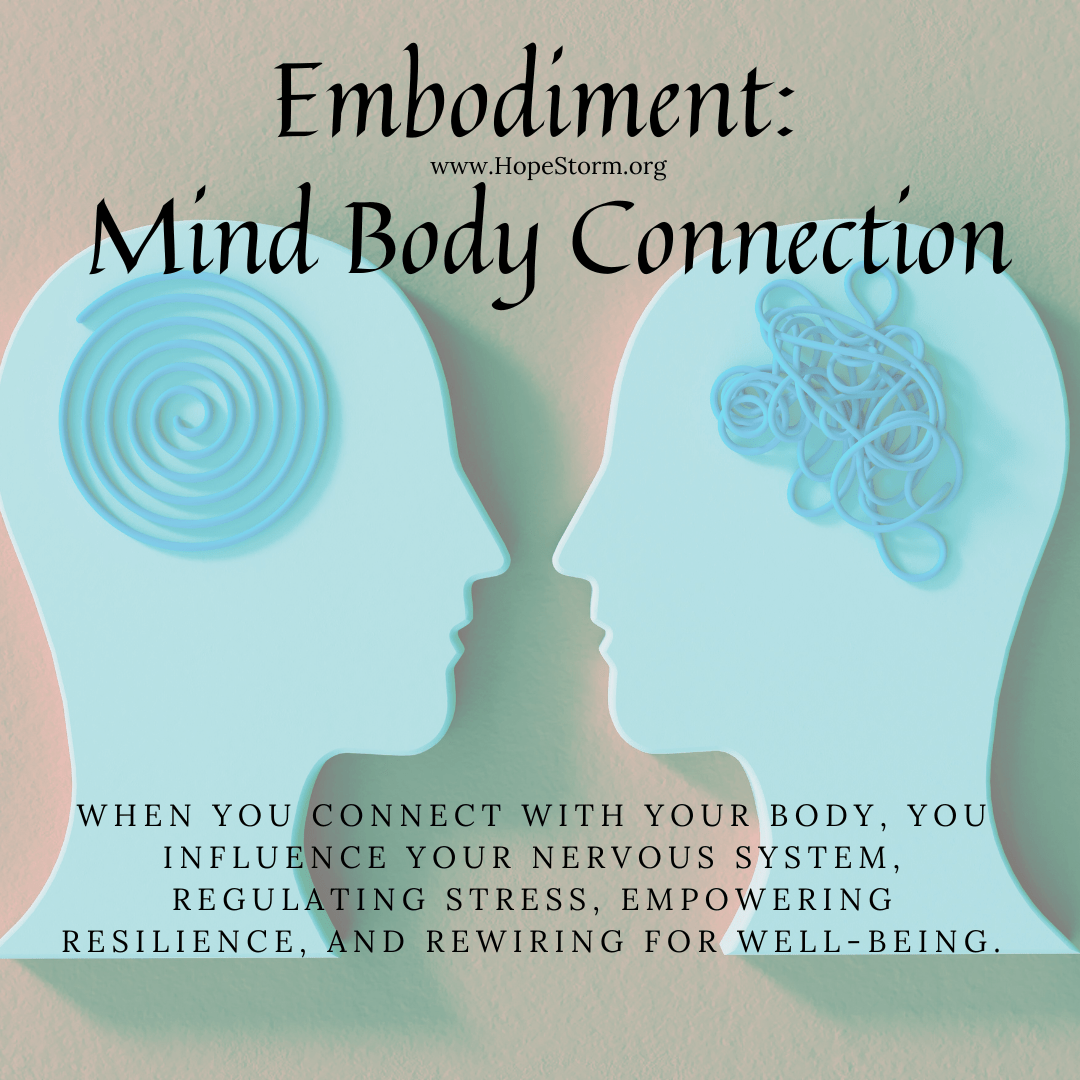
Our nervous systems overwhelmingly affect our psychology. Our embodiment can significantly influence our nervous systems. Suffice it to say, embodiment not only improves our connection and awareness but also can impact our nervous system regulation, stress response, cortisol regulation, mind-body connection, vagal tone, neuroplasticity, pain perception, emotional regulation, body schema and body image, and much more. Regular engagement in embodiment practices is associated with improved overall well-being and resilience to the effects of stress, and maybe, just maybe, not forcing your lack of planning or lack of personal awareness on others during our morning commute.
Always hopeful.
 Hope Storm | Coaching · Consulting · Hypnotherapy