On a wild ride of disembodied commuting!

Most days, as I commute to take my toddler to daycare and then back to my home office, I frequently find myself saying in my head “your lack of planning in not my emergency,” as people ride on my rear, throw their hands in the air, and even pass in no passing zones.  It is my gentle reminder to myself that I don’t own their frustrations, nor do I have to change my behavior or my rate of speed because of their irritation.

I do follow the speed limit *gasp* not only for safety and respect reasons but also to be an example to my child.  I use my blinker.  I also stop at stop signs and yield at yield signs, even when no one is around to see me.  I do this because I honor the lives, safety, and health of others (and I want my child to know that this is how we respond to those around us, with regard).  I acknowledge that my responsibility as a driver is to behave in such a way that we all make it home at night to our loved ones, family, friends, fur babies, lizards, whatever it might be.  But that is not what prompted this writing today.

This morning, as I was driving back home from daycare drop-off, I had an individual doing all the things I had listed above.  Riding my rear, throwing hands, and I am sure if they had been able to, they would have driven through the ditch to get to their destination quicker.  I have had this thought before, but it struck me again today:  It is likely partially their lack of planning, but it may also be (to a huge degree) their lack of embodiment.  Their experience of detachment and disconnection. 

What do I mean by that when I say embodiment?  To me, embodiment is being fully connected to ourselves, our body, our sensations and emotions and the present moment.  In a sense it is like mindfulness but rather than practicing and experiencing awareness and focus, embodiment is practicing and experiencing connection.  They are closely related and have quite a bit of crossover. 

A couple years ago I took an embodiment certification course.  I was in a small group with some fabulous people from around the country, and we met each week to practice with each other and discuss our curriculum.  On one occasion we were discussing how being disembodied (a sense of detachment or disconnection from one’s own body, emotions, or surroundings, manifesting as a feeling of being separated from physical sensations, emotions, or the present moment) can be attributed to so many things in our society.  The behavior of our politicians, the feeling of tension in so many public places, the big (seemingly exaggerated) responses to life events and inconveniences we see from people, etc.  We discussed how different our communities and the world might be if more people took the time to not only be mindful but to connect, to become embodied. 

Today, I was reminded of all those things.  The importance of embodiment.  How being disembodied leads us to behave in ways that we may not be so proud of if we had that connection and took the time to be aware and present.  How our disembodiment puts tension into the collective space.  How being in a hurry is a sign of disembodiment. 

So how do you know you are disembodied?  Here are some examples:

  1. Dissociation
  2. Difficulty in feeling or expressing emotions
  3. Physical discomfort
  4. Being in a hurry
  5. Impatience with others
  6. Disconnection from surroundings
  7. Memory gaps
  8. Avoidance of physical sensations
  9. Too much screen time (tv, phone, or even reading)
  10. Emotional shutdown
  11. Eating on autopilot
  12. Daydreaming
  13. Multitasking without focus
  14. Auto responding to conversations or emails
  15. Perfectionism
  16. Responses to situations that appear to be emotionally immature
  17. Responding to fear ineffectively (suppressing, illogical, divisive)

And the list goes on and on…

My mind’s gentle reminder brought empathy into my body for this person.  While they were clearly driving in a way that I would not deem safe, I found a sense of connection with myself and then with them, identifying that they were likely experiencing the world (at least in that moment) in a way that was disconnected from themselves and from others (me). 

Now, don’t think for one second that I don’t have those moments too.  I struggle with being mindful and embodied on the regular.  I find that for me, these moments are usually when I am dysregulated.  They probably go hand in hand.  It is ongoing work to be connected and aware.

So, did any of those examples relate to you or someone you know?  I could almost guarantee that they did.  My sure signs of disembodiment in myself are dissociation (usually with a screen), memory gaps, and impatience.  I also occasionally find myself multitasking without focus and being a bit of a perfectionist (that one is a long-fought battle of a first born with type A personality and recovering people pleasing personality, or so the theories go).  We all have some tell tale sign of disconnection in our body.  Identifying those and finding ways to be more aware of them can make a big difference in how we relate to ourselves and those around us.

One thing to note about embodiment is that it isn’t a one-time thing.  It is a practice.  It is something we must keep doing every day for it to work and keep working.  Kind of like eating healthy and exercising, we can’t do it once and expect to look and be fit and healthy.  Here are some examples of ways to become more embodied:

  1. Regular body check-ins
  2. Body scan meditations
  3. Mindful breathing
  4. Yoga
  5. Tai chi
  6. Progressive muscle relaxation
  7. Somatic work
  8. Grounding
  9. Dance or movement meditation
  10. Sensory awareness
  11. Nature connection or earthing
  12. Creative expression
  13. Mindful eating
  14. Qigong
  15. Meditation/mindfulness in motion
  16. Feldenkrais method
  17. Martial arts
  18. Play
  19. Mindful stretching
  20. Floatation tanks
  21. Body-informed decision making
  22. Progressive grounding
  23. Self-massage
  24. Laughter yoga
  25. Positive affirmations
  26. Gratitude practice
  27. Imagery or visualization
  28. Sound therapy/healing
  29. Five senses grounding/check-in
  30. Embodied communication
  31. Nervous system regulation exercises or practices
  32. Free flow dance
  33. Improv
  34. Tapping/EFT
  35. Reiki
  36. Animal connections
  37. Co-regulation

This is not an exhaustive list, but these are some tops ones that came to mind that I frequently recommend to my clients as we work on their unique healing journeys.

A big part of healing, maybe the biggest part, is connecting.  Reconnecting and connecting to ourselves, and others, and the planet.  Everything.  I firmly believe that we cannot heal until we reconnect.

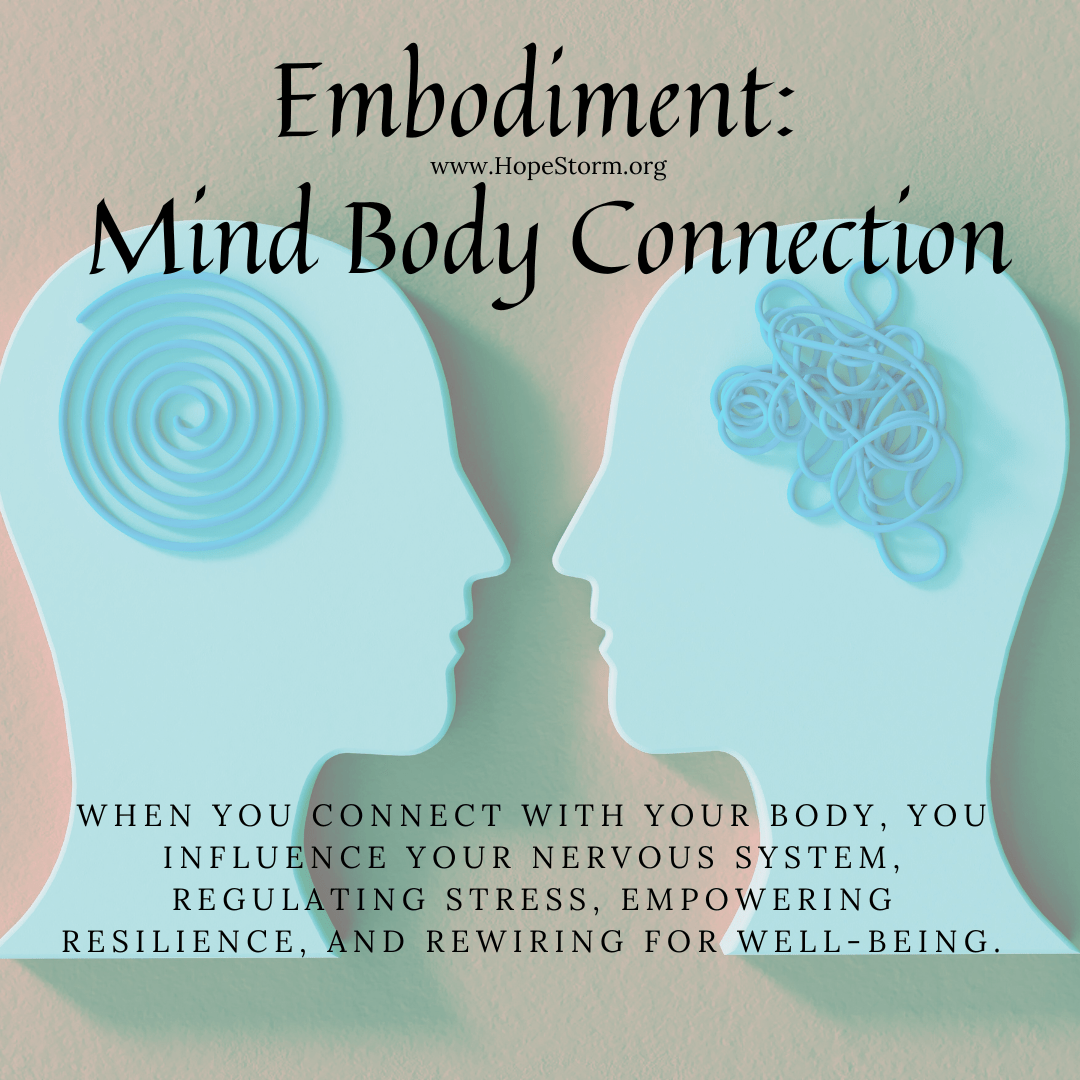
Our nervous systems overwhelmingly affect our psychology.  Our embodiment can significantly influence our nervous systems.  Suffice it to say, embodiment not only improves our connection and awareness but also can impact our nervous system regulation, stress response, cortisol regulation, mind-body connection, vagal tone, neuroplasticity, pain perception, emotional regulation, body schema and body image, and much more.  Regular engagement in embodiment practices is associated with improved overall well-being and resilience to the effects of stress, and maybe, just maybe, not forcing your lack of planning or lack of personal awareness on others during our morning commute. 

Always hopeful.

Navigating the Depths of Grief: Embracing Compassion Amidst Global Turmoil

In a world saturated with headlines of wars and conflicts, eliciting fear and profound grief for so many, it’s entirely normal to feel a deep sense of sorrow when confronted with the loss of someone familiar, like Matthew Perry. However, amidst the swell of emotions, a sense of shame might creep in, suggesting that this sorrow is somehow inappropriate in the face of more extensive tragedies, such as those in Ukraine and Israel, mass shootings, poverty, etc.

Grief, in all its intricate forms, is full of human emotion. It impacts our lives in so many ways, responding not only to widespread catastrophes but also to personal loss and connection. Various hardships may unfold simultaneously and grief is not a competition.

Matthew Perry, known to many as Chandler Bing from “Friends,” may be a distant figure in our lives, yet his passing can evoke a genuine sense of personal sadness. I am sad about his passing. He was a person many of us grew up watching, navigating the highs and lows of life that were shared through the media. The emotions we feel are real and deserve acknowledgment. It’s not a betrayal of the empathy we hold for the wars and conflicts around the globe. Grief isn’t a limited resource, where mourning one loss diminishes the significance of another.

Sorrow takes on its own form. Each expression of sorrow is profoundly personal. The tragedies occurring all around the planet evoke collective empathy, and it’s entirely valid to feel the weight of those global struggles. However, recognizing personal grief for a public figure doesn’t lessen the empathy we have for the broader world.

In these moments, it’s essential to honor the uniqueness of our own emotions and experience. Grief doesn’t conform to a rigid structure, and there’s no need to compare or rank our sorrows. What truly matters is the authenticity with which we embrace our feelings and extend compassion, both to ourselves and others.

Grieving for Matthew Perry doesn’t undermine the gravity of global situations. Instead, it reaffirms our shared humanity—a gentle reminder that, amid global challenges, personal connections and individual experiences hold significance. By allowing ourselves the space to grieve, we foster a culture of empathy that acknowledges the validity of each person’s emotional journey.

As we navigate the intricate pathways of grief, let’s remember that compassion isn’t a finite resource. It can extend gracefully to both the personal and the global, creating waves of empathy that connect us all through a unique and collective experience.

Please remember, it is ok to not be ok. And it is ok to ask for help.

**I have not been able to find the artist of this photo to give them credit. If you know who did this beautiful artwork, please let me know so I may give credit where credit is due. Thank you!

Its ok to cry on the beach surrounded by 50,000 people

Sometimes we become so immersed in our daily routines that we can overlook the subtle signs that indicate we need a break or a change.  The familiarity, busyness, or even perception of our routines can sometimes mask the need for self-reflection and adjustments. 

I am human.  And won’t ever claim otherwise.  I am far from perfect, and I make mistakes.  Loads of them.  Even though I teach (and preach) self-care, self-compassion, and many related topics, I have numerous times found myself caught in the chaos of life’s demands, neglecting my own well-being.  It takes a toll, physically and emotionally. 

About six months ago, I was caught in that chaos.  I wasn’t doing what I suggest other people do and I started to get a little fried around the edges.  I took a break, regrouped, and decided to make a change.  I cleaned up my schedule, did healthy menus and cooked at home, minimized and eliminated some unhealthy influences in my life, got up and moved more, took breaks, drank more water, all the usual things.  I was feeling good.  Or so I thought.  Fast forward to a couple weeks ago…

A good friend and I were able to take an amazing trip to the east coast and spend 3 days at an ocean side music festival.  It. Was. Amazing!  It was cloudy and cool (which may not be some people’s ideal beach vacation but for my translucent skin, it was perfect).  It rained some.  There is something cleansing and healing about standing in the rain, don’t you think?  We spent the entire time with our feet in the sand, listening to the ocean waves hit the shore while these amazing bands played music.  People got along and smiled at each other.  We talked to the people around us.  Everything about it was rejuvenating.

And that’s when it hit me.  I was fried around the edges.  Again.  Just in a different way than six months before.  My energy was drained, I was disconnected from myself and the earth (and maybe a bit from my fellow humans as well).  I had been better about the chaos but maybe not as good as I should have been about the peace.  So, I spent those 3 days connecting to myself (while surrounded by 50,000 people), connecting to the earth through the rain and the wind and the sand and the ocean (and toward the end of the weekend when the clouds cleared, the moon and the sun), connecting to music (which is so good for the soul), and allowing myself to feel and release.  I danced.  I cried.  I sat in reflection.  I felt the earth. I felt the music.  I felt reconnected to it all, myself included.

I knew this but maybe didn’t consciously acknowledge it at this time in my life, but through this experience, I was reminded that healing and self-care do not exists on a linear path; there are ups and downs, progress and setbacks. I was doing well in some areas but needed to reassess in some others.  I needed to notice the subtle cues-the restlessness, the weariness, the diminished enthusiasm, the feelings of disconnection. Self-care isn’t just about the big, intentional acts; it’s also about attuning ourselves to the whispers of our own needs.  My needs were telling me that I needed connection (and apparently a sandy beach in Maryland 😉).

We don’t always have the chance to go to a sandy beach in Maryland.  I never have before.  Or a beach at all.  I live in a landlocked state, beaches take time and effort and money.  But we can listen to those whispers and make those adjustments.  Take those breaks.  Our bodies speak our truth and we will know exactly what to do if we just listen.

What’s the point of all of this?  We all need a reminder sometimes.  Even me!

Find was nourishes your soul.

Embrace the idea that healing is a process unique to you.

Self-care is not a luxury but a fundamental part of your journey.

Even when we feel we are doing it all right, sometimes we need a break or a change.

Its ok to take a step back.  Its ok to make adjustments.  Its ok to ask for support.

Its ok to cry on the beach surrounded by 50,000 people. 

Healing is a journey

Healing is a journey.  As we begin our healing, we bring our entire existence, our whole stories and our whole selves, every person and being we have ever interacted with, every experience we have had, whether consciously remembered or not, on that path with us.  We may not knowingly be aware of it, but all those things get packed up in our luggage and we carry it along.  We may not identify the load we are carrying but we can feel its weight.  We can feel it in our responses, in our interactions, in our stress, in how we eat, how we sleep, how we love ourselves, how we love others.  All of it joins us on our path. 

As we heal, pieces and parts of the contents of that luggage no longer have a place or space, and we wash them away in the rivers and creeks, during the rainstorms, with our tears.  Other pieces and parts will always stay with us because they are weaved into the fabric of the luggage we carry, but they get lighter, less noticeable.  They fade and lose impact.  The last kind of pieces and parts also stay with us, but they change.  They become something different.  They become resilience, strength, character, empathy, wisdom, courage, compassion, and so much more.  As you continue along on the healing journey, you will begin to feel your load lessen, you will begin to see the things you left behind, how other things have changed (and changed you), and how there are things that deserve your awareness but not your full attention. 

I believe that when something triggers us, it is a sign that there is a dysregulation in our nervous system, something has been left unhealed, and we have a spot along our healing journey that we must attend to.  Triggers are reminders of the pains of our pasts, but they can also be signals for healing and growth in our present.  There is no guarantee that the triggers we experience will disappear entirely but with some support and personalized healing techniques, many triggers can be reduced to more of an irritant than a day or week or month crusher.

I’ll share a personal example: 

On April 20, 2005, exactly seventeen years ago today, I was raped.

Over the next couple of months, I basically laid in bed.  I had very little drive to go to work and often wouldn’t, I frequently skipped classes and skimped on homework, I quit seeing my friends, I checked the locks on my door repeatedly, I had to always have a TV on because any noise or sound of someone outside of my apartment would startle me, I had nightmares, I was afraid to leave the house, I was afraid to run into “him.”  I was embarrassed.  I felt shame.  I felt like it was all my fault.  I didn’t want anyone to know.  I think I would have died in that bed just trying to sleep or dissociate away what had happened.  Then, one day one of my supervisors from work called to fire me.  Something sparked in me, probably a survival instinct (I will be homeless if I don’t pay my rent and I can’t pay my rent without a paycheck), and I broke down crying and told her everything.  Thankfully, I worked at an amazing organization and the director of human resources gave me another chance with the stipulation that I go to a therapist and work through my trauma.  At that point, not being homeless was a motivating factor, enough to push me to get the help I so desperately needed, so I agreed.  That director of human resources very well could have saved my life by how she handled the situation, and I will always be thankful.

I was in my early 20s when this all happened, partially through a bachelor’s degree in psychology, and didn’t know much about therapy and treatment and trauma, quite frankly.  I picked a random female counselor who took my insurance and set up my first appointment.  I met with her a few times, and then she suggested I try EMDR, which I had never heard of.  I was willing to try anything, so I agreed.  After 5 sessions of EMDR (no two experiences are the same), my nightmares were gone, the flashbacks were gone, the hyperarousal that I had been experiencing was reduced to manageable levels.  I didn’t feel like my pre-rape self, but I felt better.  I felt like I could go forward in the world again.  And that is what I did.  Until the following April. 

April came around and the nightmares started again.  The hyperarousal returned.  The flashbacks were frequent.  What was happening to me?  Hadn’t I figured this all out and resolved these issues?  It wasn’t until many, many years later that I learned about how our bodies remember and that anniversaries can be times in which things rise to the surface and we can have a return of symptoms.  I returned to counseling and did EMDR on a few occasions, usually in April. Over the years the best that I could get to was an almost complete elimination of symptoms all year long except in April.  I felt that after what I had experienced and having a PTSD diagnosis, it could be worse.  I went along with my life and was a healthy and happy member of society.  Then April would come around and I’d be a mess.  There were a few times that I even forgot about the anniversary and would ask myself why I was in such a terrible mood or why everything was causing me such stress, or why I had such an emotional reaction to everything.  Then one day I would have a nightmare, or a flashback and it would hit me.  Duh!  Anniversary.  Looking back on it with the knowledge I have today, it all makes perfect sense, but at the time it was so strange and quite unnerving. 

As time has gone on and I have advanced my education and experience and become an expert in trauma, I have found that EMDR is a fantastic modality for many people (it obviously worked for me) but there are so many more that can be used outside of a therapist’s office which are also very effective.  Many of these things can be taught to a person and they can use them in their own time and in their own space.  I now do that for myself and for others.  April is now different for me.  It is a time of greater self-care, where I focus on the things that make me happy and try to make new and wonderful memories.  April is a month of regulation, nature, and love.  April is still a time when I am more sensitive to things than I normally would be but there are no nightmares, there are no flashbacks, there is no extreme hyperarousal.  I am the same me with a slightly lower tolerance for stress and a slightly higher potential of tears when I feel an emotion. 

When I talk about the luggage we take with us on our healing journey, this experience from seventeen years ago is one of mine that is woven into the fabric.  It has changed.  The impact is less.  It has faded but has not completely disappeared and I don’t know if it ever will.  It is manageable and bearable and has been for quite a long time now.  I anticipate that it will continue that way but if it does stir back up, I know what to do and how to help myself.  It will be a point in my journey that deserves my attention.

I don’t think that healing is a journey with a destination, an end point.  But many other things come along on the path like freedom, change and growth, ups and downs, control or a release of the need for control, resilience, and a sense of calm.  So as each one of us embarks upon or continues on our unique healing journeys, remember that the pieces and parts we take along in our luggage don’t always disappear, but they can be reduced to a minor irritant with intention and the right techniques.  I hope you find your luggage lighter, and your attention focused on things that bring you contentment and peace.

The Art of an Effective Apology

“I’m sorry.” 

“I was wrong.” 

“That was thoughtless of me.”

“It wasn’t my intention, but I know I hurt you.”

“Please forgive me.”

“Excuse my behavior.”

“I made a mistake.”

“I want to apologize for….”

“I regret….”

“It was my fault.”

Apologizing is a simple concept with a process that many of us are taught as small children, but many people find the art of an effective apology elusive.

Pain is often the root of our desire to receive an apology.  Emotional pain, physical pain, the pain of disappointed expectations, rejection, lack of respect, and on and on.

What is the root of our inability to give an apology?  Fear?  Unwillingness to admit that our actions caused someone pain?  Pride? Lack of care?  Lack of empathy? Disregard for the relationship?  Low self-worth?

We have all been hit with the insincere apology.  The apology that feels like its just words in the wind. 

We have all experienced the nonexistent apology.  The apology that never came.

We have all experienced the apology that feels a lot like gaslighting and somehow makes you feel like whatever happened was your fault or you are wrong for being upset about it.

We have all had an apology that turns into many apologies as the same behavior is repeated time and time again, and eventually it’s just words with no meaning.

When it comes to apologies, we can’t force anyone to be sorry or say they are sorry.  An apology is not required for forgiveness.  Forgiveness is a personal journey that we take with or without the input from another person.  An apology is, however, essential for reconciliation.  It is a step toward rebuilding trust and mending the relationship (if that is the outcome you want).  Everyone makes mistakes.  Providing an apology isn’t saying you behaved intentionally to cause pain.  It is ultimately saying that that you are acknowledging that the impact of your behavior was greater than the intent, your relationship is more important than your pride, and you can affirm that something you did caused harm to another in some way.

That intent thing really seems to catch a lot of people. “Well, I didn’t mean to…”  Most people can be sure you didn’t, but it doesn’t matter.  You don’t get to decide if, when, or how your behavior affected another.  If someone shares with you that something you did caused them pain, then that is real for them.  You don’t get to decide how your words and actions are received.  The impact means more than the intent. 

So, how do we learn this elusive art of an effective apology?  Do it.  Follow through.  Be sincere.  Science provides a list of six steps to take which have been shown to be most effective and meaningful.  These are:

  1. Show or state regret (I’m sorry for…)
  2. Explain what went wrong
  3. Claim responsibility for the impact
  4. Declare repentance or restitution
  5. Promise change, offer repair
  6. Request forgiveness

These are all great.  But I am going to simplify this to make it even easier (you choose which list you prefer):

  1. Apologize and mean it
  2. Actively work toward changing the behavior, aiming to not repeat in the future
  3. Behave in a way that shows repair of the relationship and rebuilding trust is the goal

I had a counselor once that told me “actions are truth,” and I have reminded myself of that almost daily for a decade.  Words are great.  Some people thrive off the words they hear, but for many, words are just words.  They can be empty promises.  They can be insincere.  They can be a desire to avoid conflict.  They can be blaming or finger pointing.  They can be a win or lose battle.  This isn’t always the case, but if you’re actions don’t reflect your words, then they are just words.  Actions.  Are.  Truth.

If you are a person waiting for an apology that may never come, my heart goes out to you.

If you are a person who needs to issue a true, heartfelt apology, I hope that this was helpful.  Put yourself if the other person’s shoes and imagine how your behavior affected them.  Apologizing isn’t a sign of weakness and shouldn’t come with shame.  It is a sign of strength and character.  Could there be consequences?  Of course.  Being aware of your own actions and humility to empathize with the feelings of others is a superpower (in my professional opinion 😉).